
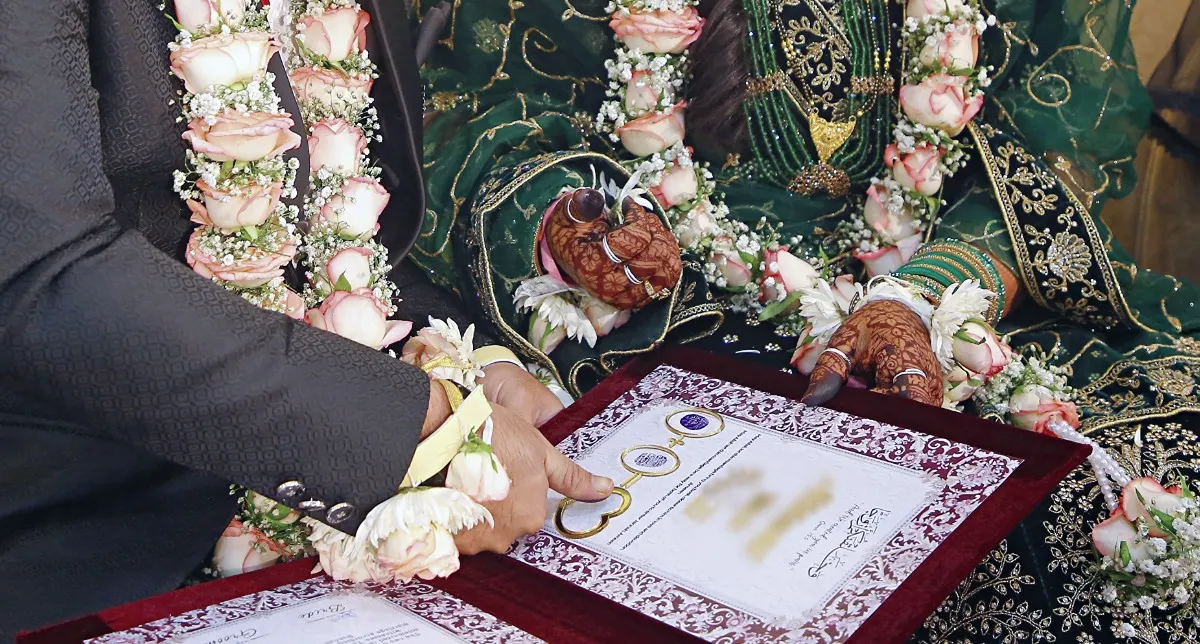
Legal recognition of a Nikah in England & Wales

Partner
Many Muslim couples enter into a Nikah believing it creates a legally recognised marriage. In England & Wales, that is not always the case.
Where a marriage does not comply with the requirements of English law, it will be treated as a ‘non-qualifying ceremony’, meaning it has no legal effect. This distinction can have significant consequences on separation or death, particularly in relation to financial claims and inheritance.
Couples in a non-qualifying marriage are treated, in law, as cohabitees rather than spouses. This distinction has significant legal consequences, particularly in the event of relationship breakdown or death, as cohabitees do not benefit from the financial protections available to married couples.
In practice, however, many such relationships are regarded as marriages by the parties themselves, their families, their community, and sometimes even by state institutions such as schools, hospitals and, in certain circumstances, tax or benefits authorities. This disconnect between social reality and legal status often comes as a surprise when legal issues arise.
This often only becomes clear when a relationship breaks down, at which point, affected individuals are likely to need specialist legal advice.
The legal status of a Nikah in England & Wales
A Nikah conducted within England & Wales will only amount to a legally recognised marriage if it meets the statutory requirements of English law. Whether a Nikah is legally valid depends on three key factors:
- The steps taken before the ceremony.
- The location of the ceremony.
- IWho was present at the ceremony.
When is a religious marriage legally valid?
Under the current legal framework, a valid marriage in England & Wales must fall into one of the following categories:
- A civil marriage.
- A marriage solemnised according to the rites of the Church of England or the Church in Wales.
- A marriage conducted in accordance with Jewish or Quaker customs.
- A marriage according to any other religious rites (including Muslim or Catholic), provided that it takes place:
- In a registered place of worship, and
- In a building that is registered for the purpose of religious marriage.
English marriage law places particular emphasis on the venue in which the ceremony is conducted. Recognised venues include:
- A register office.
- Approved premises.
- A Church of England or Church in Wales building.
- A registered religious building that has been both:
- Certified as a place of worship; and
- Registered for marriages.
Compliance with the Marriage Act 1949
Even where a Nikah takes place in a mosque in England or Wales, it will only be legally binding if the couple has complied with the formal requirements of the Marriage Act 1949. This includes:
- Giving formal notice of the marriage at a register office.
- Using the prescribed form of words during the ceremony, in the presence of:
- A registrar, or
- An authorised person.
If these steps are not followed, the Nikah will remain a religious-only, non-qualifying ceremony, regardless of where it takes place.
When is an Islamic marriage not recognised in law and why?
The number of couples in religious-only Islamic marriages conducted in England & Wales is not known, but it is widely accepted that they are common. Reasons for this include:
- One or both parties being unaware that a Nikah alone does not create a legal marriage.
- Misinformation given by the person conducting the religious ceremony.
- One party deliberately misleading the other, often the bride and her family, about the legal effect of the marriage.
In some cases, the party seeking to avoid a civil marriage is the financially stronger party. Reasons cited may include a desire to:
- Protect self-made assets.
- Preserve the benefit of a previous divorce settlement.
- Safeguard inherited or family wealth.
- Avoid potential financial claims in the event of separation.
Joint decisions not to legalise a marriage
There are also situations in which both parties knowingly agree to enter into a non-recognised marriage. This may occur where:
- The couple seek to only satisfy religious requirements.
- They wish to keep the marriage private or secret.
- They intend to register a civil marriage at a later date, which may never take place.
The legal and financial consequences
The legal and financial consequences of a non-recognised Islamic marriage can be far-reaching, particularly for women.
If the relationship breaks down, a spouse in a non-qualifying marriage cannot apply for financial remedies under the Matrimonial Causes Act 1973, regardless of the length of the relationship or any financial dependence.
If the husband dies, the surviving wife will not be treated as a legal widow. This means she will not automatically benefit from:
- Spousal pension entitlements.
- Inheritance under the intestacy rules.
- Certain tax exemptions are available to surviving spouses.
Unexpected tax liabilities and financial insecurity can therefore arise at a time of significant vulnerability.
In many cases, individuals assume they will have the same rights as a spouse, only to discover that the legal position is very different.
Final thoughts
The legal status of Islamic marriages in England & Wales continues to raise complex social and legal issues. Understanding whether a Nikah is legally recognised – or how it can be made legally binding – is essential to avoiding unintended and potentially serious consequences.
The wider legal and academic discussions on cohabitation law reform must also address this complex issue.
If you are unsure whether your marriage is legally recognised or how this may affect your rights and financial position, talking to a family lawyer or Islamic divorce lawyer can help you understand, plan and avoid unintended consequences.
More from Nazia Rashid
Government launches consultation on cohabiting couples' rights
The government has opened a consultation on cohabitation law reform, proposing new rights for cohabiting couples on separation Here's what's proposed and what to do now.
Islamic marriage and divorce in England & Wales
Islamic marriage in England & Wales: how Nikah, Mahr and civil law interact, and what families with international ties need to know on divorce.

Conduct in financial remedy proceedings - case law insights
Explore how conduct affects financial remedy proceedings, from the 'obvious and gross' threshold to recent rulings on economic abuse and coercive control.